 Arloom
Dad mixed up the year again. Everyone laughed.
That's the moment a story starts to drift. Save the version he's telling today — while it's still exactly his, and while your kids can still hear him tell it. The first memory card is ready within minutes.
Your email is all we ask for. We'll tell you the moment it's your turn — no spam, nothing else asked for yet.
The thing nobody has a name for
We call this Story Drift.
It happens at every family dinner. Someone tells a story they've told a hundred times — and this time a name is wrong, or the year is off by a decade. Everyone laughs and moves on. Nobody notices the story just changed a little, permanently.
Arloom exists to catch the version that's still true, starting with something you probably already have — a Nearling's voice note, an old video, a scanned letter.
If this is urgent, don't wait for us.
Arloom isn't out yet. If you're reading this at 1am because something changed in your family, you can't afford to wait for our launch — and we'd rather you had the recording than had our app.
So here's how to do it well, this Sunday, with the phone already in your pocket. It doesn't mention us again, and it's not gated behind an email.
Read the guide — no email needed It's urgent — get me into the beta
Anything you record today will import into Arloom later. You lose nothing by starting without us.
Three steps. No manual required.
Import what you already have
A voice note, an old video, a scanned letter. Or record something new. Up to 500 MB, 50 files at once.
Add it to a Nearling
The people close to you — yes, that includes you.
Get a card, then ask
With a free account, Arloom transcribes it and turns it into a memory card within minutes. Later, Weaves lets you ask about it.
What you end up with
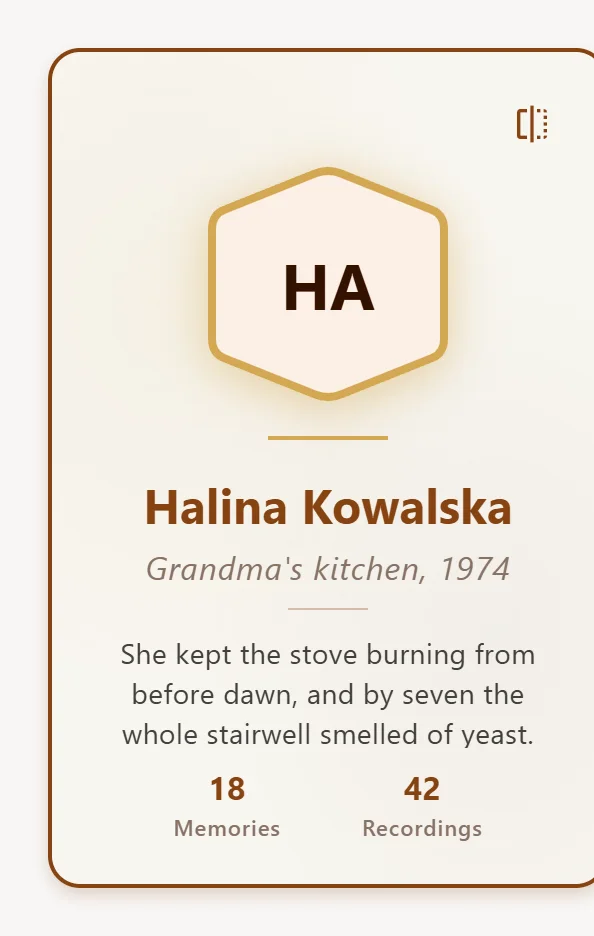
A memory card, in their own words.
Record twenty minutes at Sunday lunch, or import a voice message you already have. A few minutes later there's a card: the story, told in the words they used, linked to the people in it — with the original recording kept underneath it.
Transcript · illustrative, not a real customer …my mother, she never once complained about the war years. Not once. She'd just say, "Complaining doesn't put bread on the table — working does." That's how she got through it. And honestly, that's how I got through raising four kids alone after your grandfather passed.
What the card keeps
- StoryHow her mother got through the war years by working, not complaining — and how she did the same, raising four children alone
- In her words"Complaining doesn't put bread on the table — working does."
- PeopleHer mother · your grandfather
- RecordingThe original audio, kept with the card
- Ask next time"What work did your mother do during the war?"
The card is written from the transcript, and the recording stays attached to it. Anyone in the family can listen to what was actually said — or have the card read aloud by a narrator voice, which is synthetic and never pretends to be theirs.
Weaves
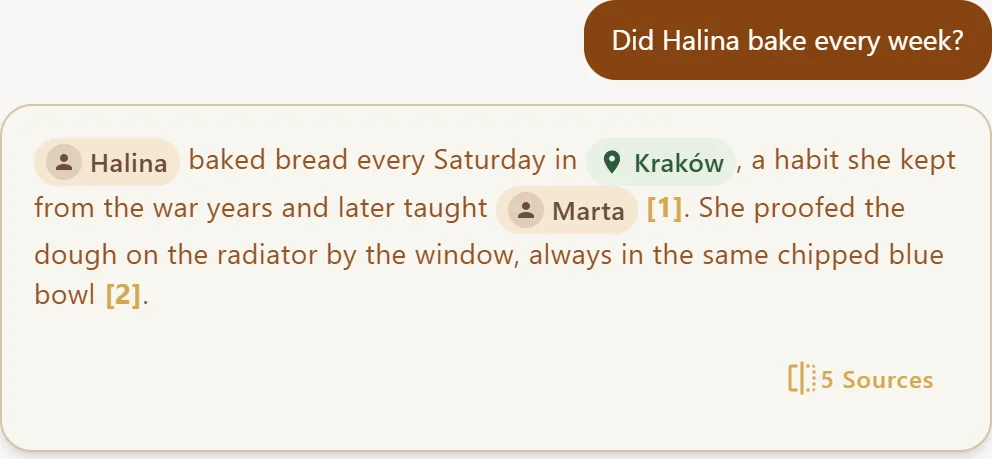
Ask your archive anything.
Try asking: "What traditions do my Nearlings have?" — a real Quick Weave prompt from the app.
Answers come only from your Nearlings' own recordings — never the open internet, never a guess. If the answer isn't clearly backed by what someone actually said, Weaves won't show it to you at all.
Privacy
Real controls, honestly explained.
Cloud AI is your choice, and Arloom asks before anything goes to it. Say no, or use the app as a guest, and your recordings stay on your phone. That also means they aren't backed up anywhere — lose the phone and you lose them — and we'd rather you heard that from us.
Say yes, and transcription, memory cards and Weaves run on Google Cloud. Your data is processed in the EU.
Everything is encrypted in transit and at rest — we won't call it end-to-end, because it isn't, and we'd rather tell you that than pretend. No ads, ever.
Our AI reads the words in your stories. It doesn't analyse voices or faces.
Everything else
Follow-up questions
After each memory, Arloom suggests what to ask next time, so the second conversation goes deeper than the first.
Hear it again
Play the original recording, or have the card read aloud by a narrator voice that is clearly synthetic.
Memory Arc
Sit back and watch your cards play one after another.
On This Day
Memories recorded on this date in earlier years, inside the app.
Share a card
Send a memory card as an image to the rest of the family.
Works offline
Recording works fully offline and syncs when you're back. Transcription needs a connection.
Next
What we're building next
Two things are planned. They aren't in the app yet, and we won't put a date on them until they're ready.
Private AI on your phone
Planned: AI that runs on the phone itself, for the memories you'd rather not send to the cloud. Until then, cloud AI stays optional.
A shared family archive
Planned: invite the rest of the family into one archive, so a sibling can add the recordings they have too.
Who it's for
"I want my kids to know their great-grandmother's voice."
Record her at Sunday lunch, or start with a voice message she already sent you. The first memory card is ready within minutes.
"My father passed a few years ago. I wish I'd recorded more."
Even one old voicemail is a starting point, not a consolation prize.
"My mom's memory isn't quite what it used to be."
Start with something you already have — no new conversation required to begin.
"I've been building our family tree for years."
Attach real voices to the names and dates you already have — add each person, link their stories, and check every answer against what was actually said.
Tell someone in the family.
It's easier with two of you — one asks the questions, the other keeps the conversation going. Send this to a sibling or a cousin and put both your names on the list now. A shared family archive is planned; until then, each of you keeps your own.
"I found this — it saves your family's actual stories, not just names and dates. I put us both on the waitlist, want to check it out?"
What it'll cost later — and what joining now gets you.
- Record, transcribe and make memory cards
- A monthly allowance of AI processing
- Real cloud storage — not a local-only trial
- Full export of everything, any time
- Everything in Free
- A larger monthly allowance for recordings, memory cards, narration and Weaves
We'll publish the Premium price and the monthly allowances before launch, once they're final — not before.
Founding members
Join the waitlist now and we'll lock in founding-member pricing on Premium for as long as you stay a member. We'll confirm the exact rate in your first email — we're not going to invent a discount before we've set one.
The questions that actually matter for something this permanent
Legacy & data trust
You haven't launched yet. Why should I trust you with something this important?
You're not being asked to yet: an email address is all the waitlist asks you for. Alongside it we keep which page and language you signed up from, so we know how to follow up, plus a one-way hash of your IP and the user-agent string your browser sends, held to stop the form being abused. All of it is written down in the privacy policy. And we're stating our data commitments now, before there's anything real at stake. You can hold us to what's on this page.
Can I get my recordings out whenever I want?
Yes — and this already works in the app today. A full export of your relatives, memories, recordings, consents and chat sessions is available on demand, delivered as a download link. It's not a paid feature: the free plan can export everything too. One export per 24 hours.
If I stop paying, do I lose my archive?
No. Storage limits are checked when you add something, not afterwards. Drop to the free plan and everything you've already recorded stays exactly where it is — you just can't add more until you resubscribe.
The one limit we want you to hear from us, not discover later: we have a written policy for free accounts that go completely unused for two years, under which their recordings, memories and files would be deleted while the account itself stays. It is not enforced yet. Nothing is deleted for inactivity today and no warning emails are sent, and we will update this page before that changes. Paid subscriptions are exempt.
Is my family's data used to train AI models?
No. Your recordings, transcripts and stories are processed to produce your results and are never used to train, improve or develop AI models.
Who owns the recordings — me or Arloom?
You do. We process your family's recordings to build your archive; we don't claim ownership of them.
What happens to my family's recordings if Arloom shuts down someday?
We intend to commit to at least 12 months' notice and a full export before any shutdown, and to publish that commitment in the Terms rather than leaving it as a promise on a marketing page. We're telling you this is an intention today because it isn't in the Terms yet — and you should be suspicious of anyone in this category who won't tell you the difference.
We're saying it out loud because we watched it go wrong: HereAfter AI, one of the closest things to what we're building, shut down in 2026 and left families emailing an inbox nobody was reading, trying to get a grandfather's voice back.
Will Arloom ever make an AI that talks like my dead relative?
No. We won't simulate a person, living or dead. Arloom shows you what someone actually said, attributed and dated, and it will always be obvious you're reading a real recording rather than a machine speaking for them.
Questions
What happens right after I join the waitlist?
Not much, honestly. Your address goes on the list and we leave you alone. We'll email you once there's something real to say — the founding-member rate when it's set, and then a note when your turn comes round. Nothing else asked for until then.
Do I need to be tech-savvy?
If you can press a button and have a conversation, you're set.
I don't know what to ask them — where do I start?
You don't have to start with a new conversation — an old voice note or voicemail works. After each memory card, Arloom suggests follow-up questions to ask next time. Our free guide is a good starting point too.
Does it work without an internet connection?
Recording works fully offline and syncs when you're back online. Transcription and memory cards need a connection.
Is this only for after someone has passed away?
No — it's built for while people are still here to tell the story themselves. It works either way, but that's the point.
How is this different from just keeping a voice memo?
A voice memo sits there. Arloom transcribes it, turns it into a memory card linked to the people in it, and lets Weaves search or ask questions of it — checkably, this year and twenty years from now.
What languages does it support?
The app is available in English, Polish, German, French, Spanish, Portuguese (Brazil), Japanese, Chinese (Simplified), Korean and Arabic. Transcription understands many more languages than that.
Do I need permission to record someone?
Yes, and the app asks you to confirm it before your first recording. Recording a conversation without everyone's agreement may be unlawful where you live, and it's the wrong way to start this anyway — the good recordings are the ones someone wanted to make.
Someone's getting a detail wrong at dinner right now, somewhere.
This time, catch it.
Or read the free guide and record something this Sunday without us.